
Minnesota has a season that rarely gets named.
It’s not winter.
It’s not spring.
It’s the 5th season (otherwise known as the “false spring”).
It’s the stretch of weeks where snow recedes into muddy patches, temperatures teeter between freezing nights and thawing days, and winter containers can sit brown, brittle, and forgotten. The landscape feels paused. Dormant. Unfinished.
For many homeowners, this is the least flattering time of year — when yards feel tired and uninspired. At biota, we see something different. We see opportunity.
Designing With the Season — Not Against It
The false spring isn’t something to disguise. It’s a transition to design with.
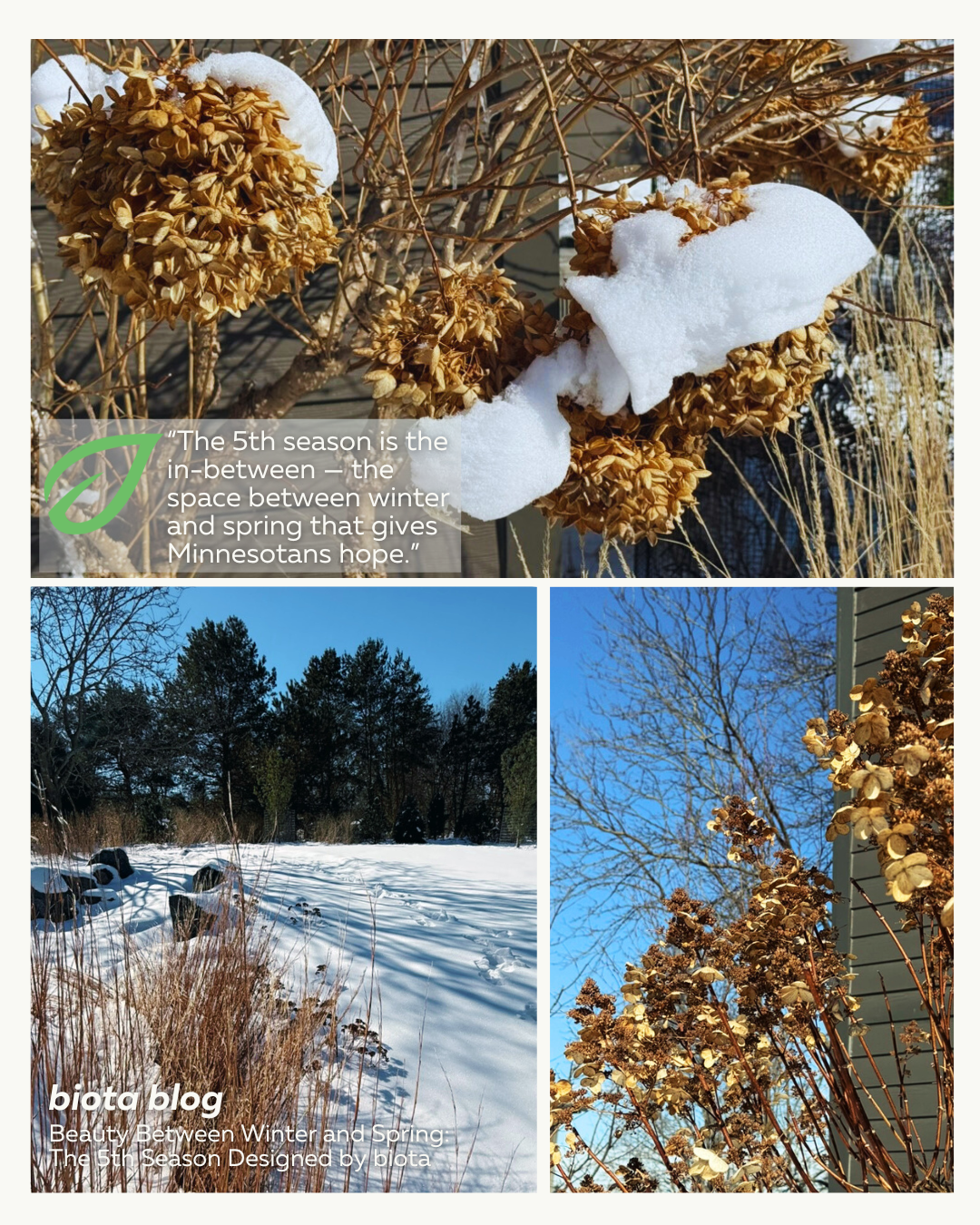
Without foliage and bloom, the architecture of a landscape becomes visible — branch structure, grading, hardscape lines, the integrity of planting design. This is when intention shows.
Brown is not the problem. Dormancy is not failure. When designed well, even this in-between season carries presence.
For JP Pizaro, our Horticulture Assistant Manager, the false spring holds something more personal:
“To me, the 5th season [false spring] is the in-between — the space between winter and spring that gives Minnesotans hope.”
After months of snow-covered landscapes, that hope doesn’t arrive in tulips. This season arrives in tone.
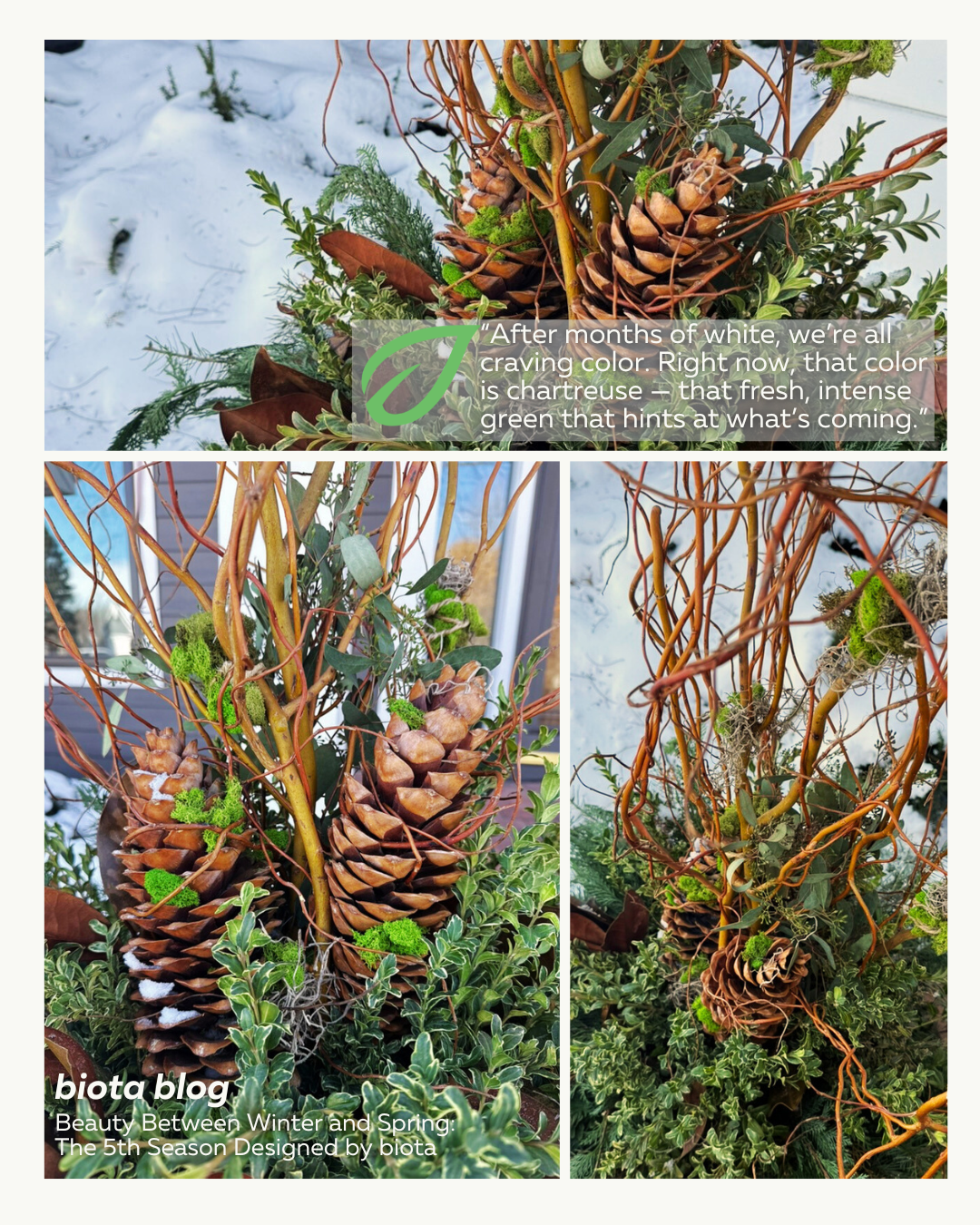
Right now, for JP, that tone is chartreuse found in reindeer moss— a fresh, intense green intentionally woven into winter containers and focal points. It signals what’s coming without pretending it’s already here.
From Brown to Beautiful: A Horticulturist’s Perspective
On a recent site visit, our horticulture team revisited a client’s winter containers for the false spring. The original cedar garland had begun to brown from sun exposure and winter dryness — particularly along the most exposed edges. In response, JP refreshed the arrangement with fresh cedar and oregonia, introducing structure, depth, and materials resilient enough to withstand Minnesota’s ongoing freeze–thaw cycles.
Preserved reindeer moss in varied green tones — alongside subtle gray hues of Spanish moss — softens compositions and recreates the layered texture inspired from a forest floor. Even when snow returns (and it will), these elements peek through with quiet vibrancy.
Preserved magnolia leaves — once glossy green earlier in winter — have aged into warm copper tones. Carolina Sapphire cypress has shifted into rusty orange, complementing woven structures of willow branches and grapevine.
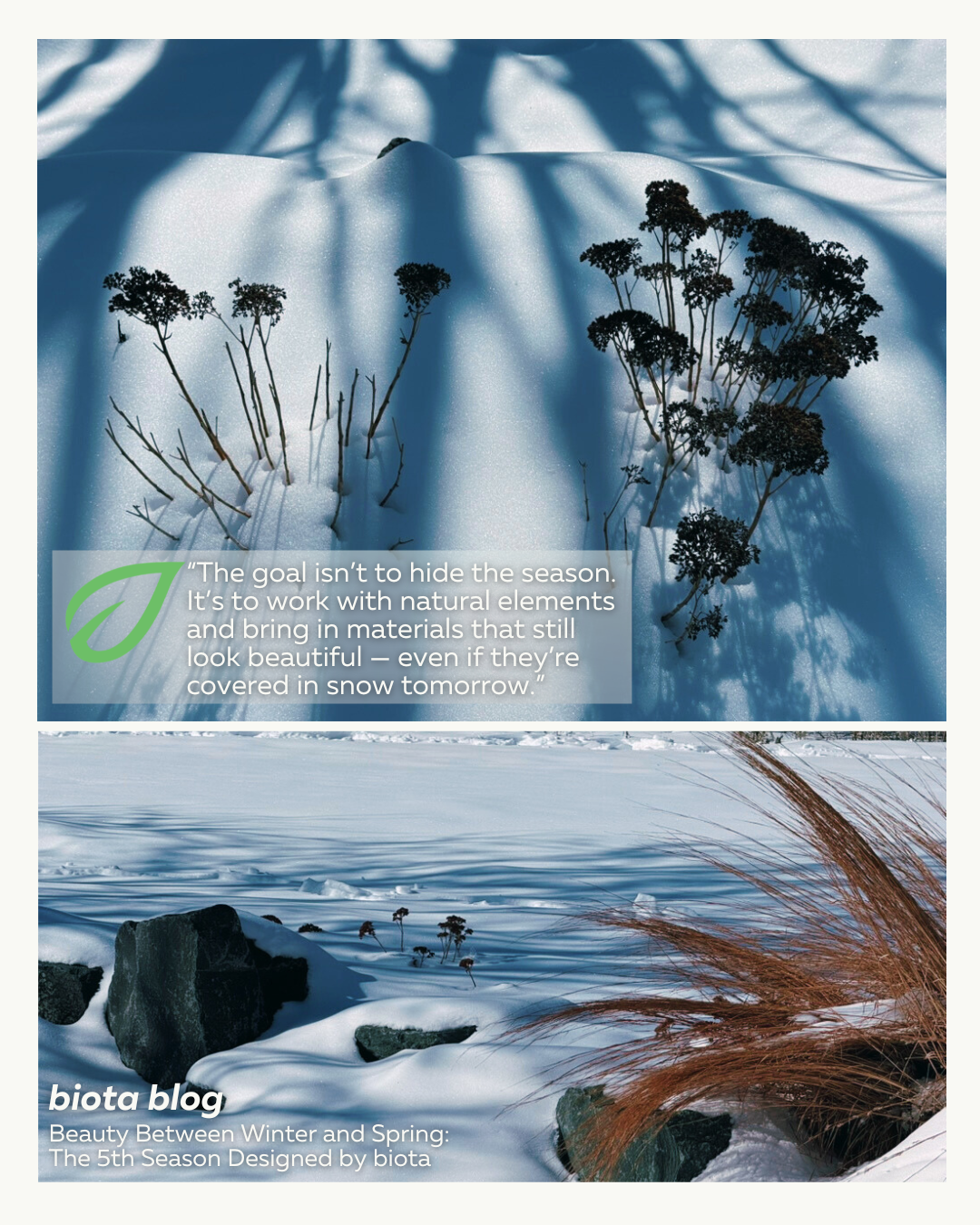
“The goal isn’t to hide the season,” JP explains. “It’s to design with materials that still look beautiful — even if we wake up to snow again tomorrow.”
Because Minnesota spring is rarely linear. A 50-degree afternoon can be followed by a five-degree night. Growth is coming — but it’s small, emerging, and fragile.
Even materials from past installations are often rehydrated, reshaped, and repurposed — extending their lifecycle and reducing waste. Grapevine wreaths can become crowns for spring containers. Dogwood and willow can even sprout second lives when planted.
“Sustainability at biota means thinking about what happens next — will this compost? Could it sprout? Could it become invasive? We’re always considering that,” JP notes.
The false spring reveals more than beauty. It reveals philosophy.
Why This Season Matters
The false spring is not simply aesthetic — it is foundational.
Freeze-thaw cycles impact soil structure. Moisture movement reveals drainage issues. Winter damage surfaces. Early attention protects plant health and preserves long-term performance.
“The 5th season [false spring] is when we come back to the property and ask: How did things winter? What needs protection? What needs refreshing?” JP asks.
We evaluate winter protection measures — burlap wraps, fencing, tree guards — ensuring vulnerable shrubs and young trees are shielded from rabbit and deer damage. We assess bark scraping that can compromise the cambium layer of young trees. We monitor snow load impacts. We determine which evergreens may recover and which may need thoughtful replacement.
Prairie plantings are intentionally left standing through winter and into early spring. They provide food sources for wildlife and allow natural reseeding to occur, allowing ecosystems to complete their cycle — reinforcing biodiversity and long-term resilience.
Sustainability, in this season, is both practical and ecological. It is stewardship.
A Year-Round Design Perspective
Biota is a design-led landscape firm serving the Twin Cities metro. Our work spans CAD renderings, 3D modeling, hardscape and planting design, lighting, construction, and long-term horticultural care. But the throughline is consistency.
We design landscapes to endure Minnesota’s full range — deep winter, high summer, and everything between. Native plant systems, structural hardscape, layered planting plans, and intentional seasonal transitions create visual continuity across all five seasons. The false spring simply makes that philosophy visible.
It’s also a moment of reconnection — with clients and with properties. Before peak spring arrives, we begin conversations about refinements, enhancements, or new projects. This season becomes a bridge — not a pause.
Beyond Waiting for Spring
Many properties look stalled this time of year.
Ours do not.
Because when design, craft, horticultural expertise, and long-term thinking come together, a landscape never feels abandoned — only evolving.
The false spring isn’t about waiting.
It’s about preparing.
It’s about noticing.
It’s about designing for what’s next.
And when the first true signs of spring finally arrive, they won’t feel sudden. They’ll feel supported.
At biota, we design landscapes that hold their integrity — and their beauty — in every phase of becoming.
Together, let’s realize your beautiful biota.
Ready to bring your vision to life? Book a design call here: click here
Winter containers needing a refresh? Book a maintenance request here: click here